


To use our advanced search functionality (to search for terms in specific content), please use syntax such as the following examples:
- Armageddon Magazine Article
- Apology Commentary
- Europe News & Prophecy
- Christmas Telecast
- Baptism Booklet
- Sabbath Roderick C. Meredith
- Abortion Gerald Weston
The Rise of the King of the South
Whiteboard: The Rise of the King of the South
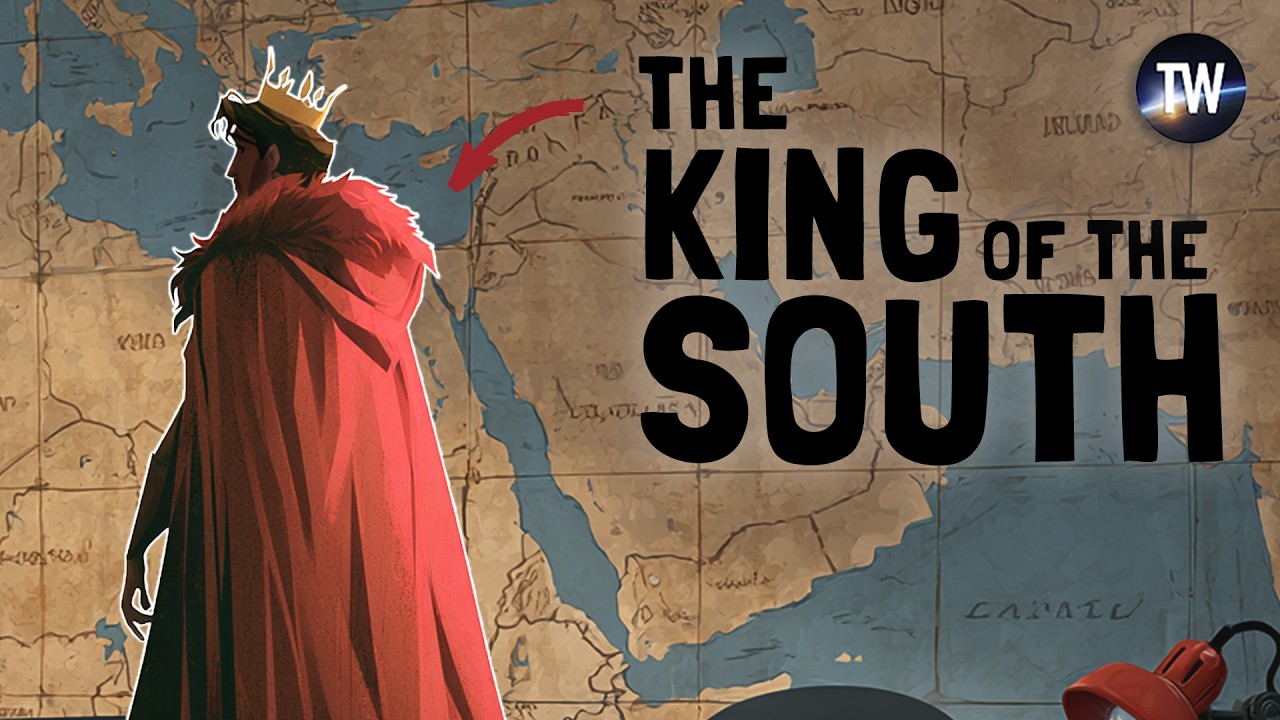
One prophetic leader will make a move that the world cannot recover from. We’ll show from Daniel 11, Ezekiel 30 and Psalm 83 where this power—the King of the South—arises, who its allies are, and how it clashes with Europe to unleash the worst time of human history.
[The text below represents an edited transcript of this Tomorrow’s World whiteboard.]
The King of the South in Bible Prophecy
The so-called “King of the South” is prophesied to rise in the not-too-distant future. And once he appears on the world scene, he’ll trigger a chain of events he will soon regret.
Even though the Bible gives clear details about which nations will make up this power, and which will not, there are still many confusing and contradictory ideas circulating today.
The danger is that people will be looking in the wrong direction as these prophecies unfold—and completely miss what’s happening.
So it’s critical to understand the small, yet pivotal role the King of the South will play, and most importantly, who will fill that role.
The name “King of the South” appears only in Daniel chapter 11. It’s there that we find the clearest description of this power and the nations connected to it. But other prophecies throughout the Bible add important details, helping paint a fuller and more complete picture.
Where Is the King of the South?
One important question that is sometimes ignored or even disregarded is south of what?
As simple as the answer may seem, it’s foundational to understanding the prophecies about the King of the South.
First, in Daniel 10:14, we see that the angel explaining the vision to Daniel was describing what would happen to his people in the latter days.
“Now I have come to make you understand what will happen to your people in the latter days, for the vision refers to many days yet to come.”
Daniel was Jewish, and these prophecies are centered on what would happen to the Jewish people in the last days.
Then in Daniel 11:41 we read that the King of the North will move against the King of the South, and on his way, “he shall also enter the Glorious Land,” that is, the land of Judah, modern-day Israel.
From there, he continues his campaign against nations listed later in the passage, which are located south of Judah and Jerusalem.
Finally, in verse 45, we’re told that the King of the North will plant“the tents of his palace between the seas and the glorious holy mountain.”
And using the Bible to interpret the Bible, the “holy mountain” is identified in Daniel 9:16 as Jerusalem.
So as straightforward as it is, the reference point for “north” and “south” in these prophecies is Jerusalem, in the modern-day land of Israel.
And the prophecies in the first part of Daniel 11 that have already been fulfilled confirm that this is exactly the case.
Who Is the King of the South?
Now it’s important to understand who the King of the South consistently refers to in this section.
Because the details of the prophecy in the first part of Daniel 11 align so precisely with recorded history, most scholars agree with what you’re about to hear. And you can even find it in many Bible commentaries.
In Daniel 11:2–3, we’re introduced to a “mighty king” who would arise from Greece and overthrow the Persian Empire. This was Alexander the Great.
Then in verse 4, we’re told that his kingdom would be broken apart and divided “toward the four winds of heaven,” but not passed on to his descendants.
Original King of the South: Ptolemy Soter and Egypt
After Alexander’s death, his empire was ultimately divided among four of his generals, who ruled over different regions.
One of those regions was south of Jerusalem.
One of his generals, Ptolemy I (Soter), who sought control of Egypt because of its extraordinary wealth, established himself as ruler in 323 BC, shortly after Alexander’s death. From Egypt, he controlled much of northern Africa and, at times, extended his influence into Judea.
He became the first ruler identified as the King of the South.
From verse 5 through the middle of the chapter, we see ongoing conflict between the King of the South and the kingdom of Syria, represented by the King of the North, spanning the next several centuries.
However, around 65 BC, the Syrian kingdom was absorbed into the Roman Empire. At that point, the title “King of the North” effectively shifted to the Roman power, aligning with the broader prophetic framework found in Daniel 2 and Daniel 7, which we’ll touch on shortly.
We may cover the fascinating history of this chapter in a future video, but for now, it’s important to understand who the King of the South consistently refers to in this section.
So, from this historical context, we clearly see the King of the South centered in Egypt—which, of course, lies south of Jerusalem.
End-Time King of the South vs King of the North
So, now that we’ve established Jerusalem as the reference point—and that historically, Egypt has fulfilled some of the prophecies associated with the King of the South—let’s look at what still needs to happen, and which nations will and won’t be part of this future power.
This brings us to “the time of the end,” as described in Daniel 11:40. “At the time of the end the king of the South shall attack him”, that is, the King of the North. But when the King of the South makes this move, it quickly proves to be a miscalculation.
In the verses leading up to this moment, the prophecy describes the rise of a powerful King of the North, who will come into Jerusalem, stop sacrifices, and set up the abomination of desolation. It also highlights the overwhelming military strength this kingdom has. Continuing in verse 40:
And the king of the North shall come against him like a whirlwind, with chariots, horsemen, and with many ships; and he shall enter the countries, overwhelm them, and pass through. He shall also enter the Glorious Land, and many countries shall be overthrown (Daniel 11:40–41).
Now, listen carefully to this next part, it’s very important:
But these shall escape from his hand; Edom, Moab, and the prominent people of Ammon (Daniel 11:41).
These peoples, identified by their historic names, have long been located in the region surrounding modern-day Israel. In fact, we can still recognize “Ammon” today, in the city of Amman, Jordan.
So as the King of the North advances, the nations immediately surrounding Israel are notably spared. Continuing on in verse 42:
He shall stretch out his hand against the countries, and the land of Egypt shall not escape. He shall have power over the treasures of gold and silver, and over all the precious things of Egypt (Daniel 11:42–43).
This makes it clear that Egypt is once again central to this southern power.
And it won’t be Egypt alone. Other North African nations are included as well. It says:
Also the Libyans and Ethiopians shall follow at his heels (Daniel 11:43).
Now there are other prophecies in Isaiah and Jeremiah that reference Egypt and its allies, similar to what we see here in Daniel. But notice this passage in Ezekiel, which also points to the nations of North Africa in connection with Egypt at the time of the end.
For the day is near, even the day of the LORD is near; it will be a day of clouds, the time of the Gentiles. The sword shall come upon Egypt, and great anguish shall be in Ethiopia , when the slain fall in Egypt, and they take away her wealth… Ethiopia [or Cush in Hebrew], Libya [translated from the Hebrew Put], Lydia [translated from the Hebrew Lud], all the mingled people, Chub, and the men of the lands who are allied, shall fall with them by the sword (Ezekiel 30:3–5).
Ancient Cush, Put, and Lud are all associated with the peoples of North Africa and are historically linked through the family lines recorded in Genesis 10.
So based on what the Bible reveals, the only clear indication of the nations making up the King of the South points to Egypt and the surrounding North African region. Now that doesn’t rule out the possibility of additional nations being involved, for example, maybe some the Arab nations located in the Arabian Peninsula.
But the only thing we can take confidence in is what Scripture explicitly identifies, and the one thing that remains consistent is that Egypt plays a central role in this southern alliance.
Who Is NOT the King of the South? | Psalm 83
But there is still an open question, and that is which nations won’t be part of the king of the South.
So let’s use scripture to establish which nations and peoples will NOT be allied with the Southern kingdom.
One of the clearest and most detailed passages for this is found in Psalm 83, beginning in verse 4.
They have said, “Come, and let us cut them off from being a nation, that the name of Israel may be remembered no more” (Psalm 83:4).
So these are nations clearly set against Israel.
For they have consulted together with one consent; they form a confederacy against You (Psalm 83:5).
This is not just opposition to Israel, but to the God of the Bible.
Now, listen to the nations listed, and remember what we saw in Daniel 11—that “these shall escape from his hand: Edom, Moab, and the prominent people of Ammon.”
Back in Psalm 83:6.
The tents of Edom and the Ishmaelites; Moab and the Hagrites; Gebal, Ammon, and Amalek; Philistia with the inhabitants of Tyre.
We see several of the same peoples mentioned—groups that historically lived in and around the region near modern-day Israel.
Interestingly, Amalek, who was a descendant of Esau (or Edom), who is known for being especially cruel and hateful, likely makes up some of the people of the non-Persian people of Iran and some of the same lineage characteristics found in Hezbollah and Hamas. At minimum, those very same traits are exhibited. (Click the link to watch the YouTube short we have on this topic in the description.)
Now, back to Psalm 83—and this is key.
Assyria also has joined with them; they have helped the children of Lot (Psalm 83:8).
The children of Lot refer to the peoples who anciently occupied what is now the modern nation of Jordan.
But the critical detail many overlook is this: “Assyria… has joined with them.” The modern-day Assyrians are the German peoples. This helps connect the broader prophetic picture.
Ultimately, the revival of the Roman Empire—the Beast power—will be led by Germany, fulfilling the role of the King of the North.
So the final Beast power led by Germany, who are the modern-day Assyrians, will be allied with the Arab peoples around the modern nation of Israel.
And while some details will only become fully clear in hindsight, the overall picture from Scripture is this: A kingdom south of Jerusalem will arise in the not-too-distant future, made up of nations around and allied with Egypt. That kingdom, known as the King of the South, will be moved to attack the German-led European superpower known as the King of the North, but will quickly be crushed by it and its Arab allies in and around the land of Israel.
On the Joe Rogan Podcast, Sam Tripoli highlighted Tomorrow’s World and the Living Church of God and what we’ve taught for decades about Germany, and how they would rise to become the leader of a coming European Superpower, that is, the King of the North.
This next video will highlight Germany’s role in end-time prophecy and highlight its connections to modern-day Assyria. Watch it and then watch the world scene and see what happens.