


To use our advanced search functionality (to search for terms in specific content), please use syntax such as the following examples:
- Armageddon Magazine Article
- Apology Commentary
- Europe News & Prophecy
- Christmas Telecast
- Baptism Booklet
- Sabbath Roderick C. Meredith
- Abortion Gerald Weston
7 Symbols in Revelation: Their Prophetic Meaning Explained
Whiteboard: 7 Symbols in Revelation: Their Prophetic Meaning Explained
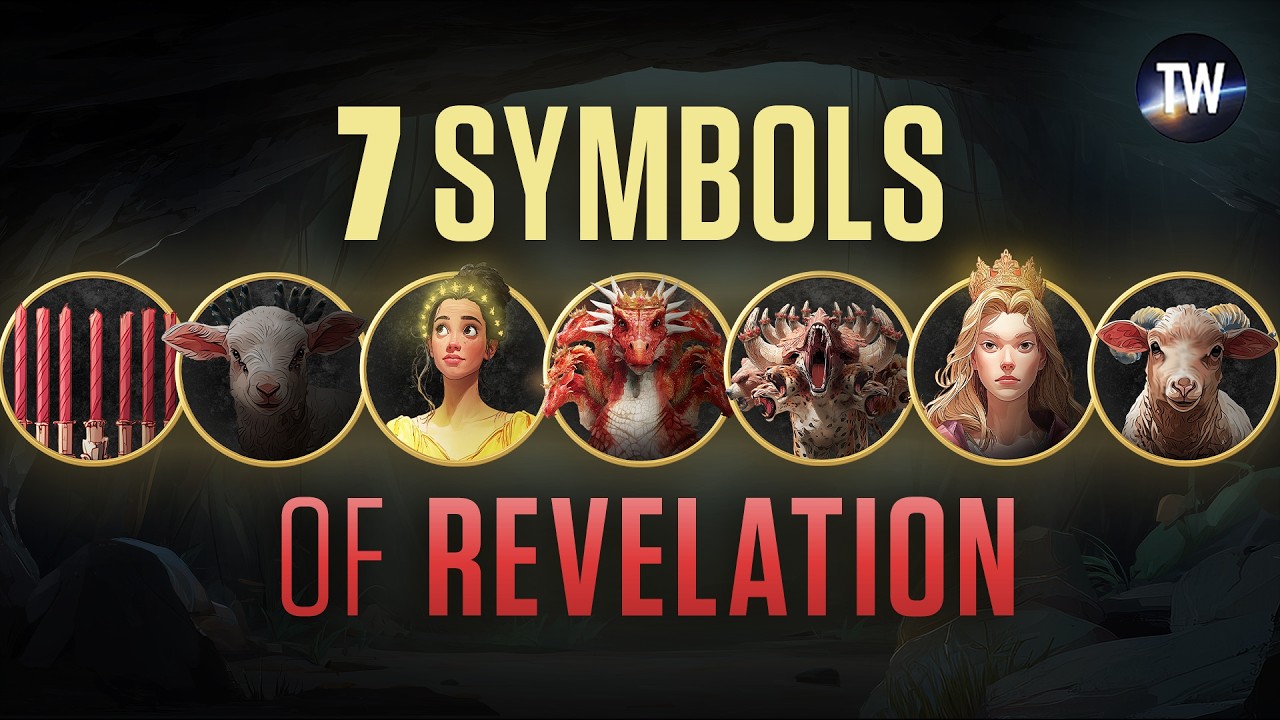
You could guess at what Revelation’s symbols mean—but the Bible already explains them. Step by step, we’ll explain seven prophetic symbols in the book of Revelation. No speculation. No guesswork. Just Scripture.
Downloadable Revelation Symbols Infographic
[The text below represents an edited transcript of this Tomorrow’s World whiteboard.]
The Prophetic Meaning of 7 Symbols in Revelation
From the seven golden lampstands and the seven stars to the Lamb of God and the beast that looks like a lamb but speaks like a dragon—all of these symbols can be found in the book of Revelation and can be clearly understood simply by using the Bible to interpret them for us. And that’s what we’ll do in this video.
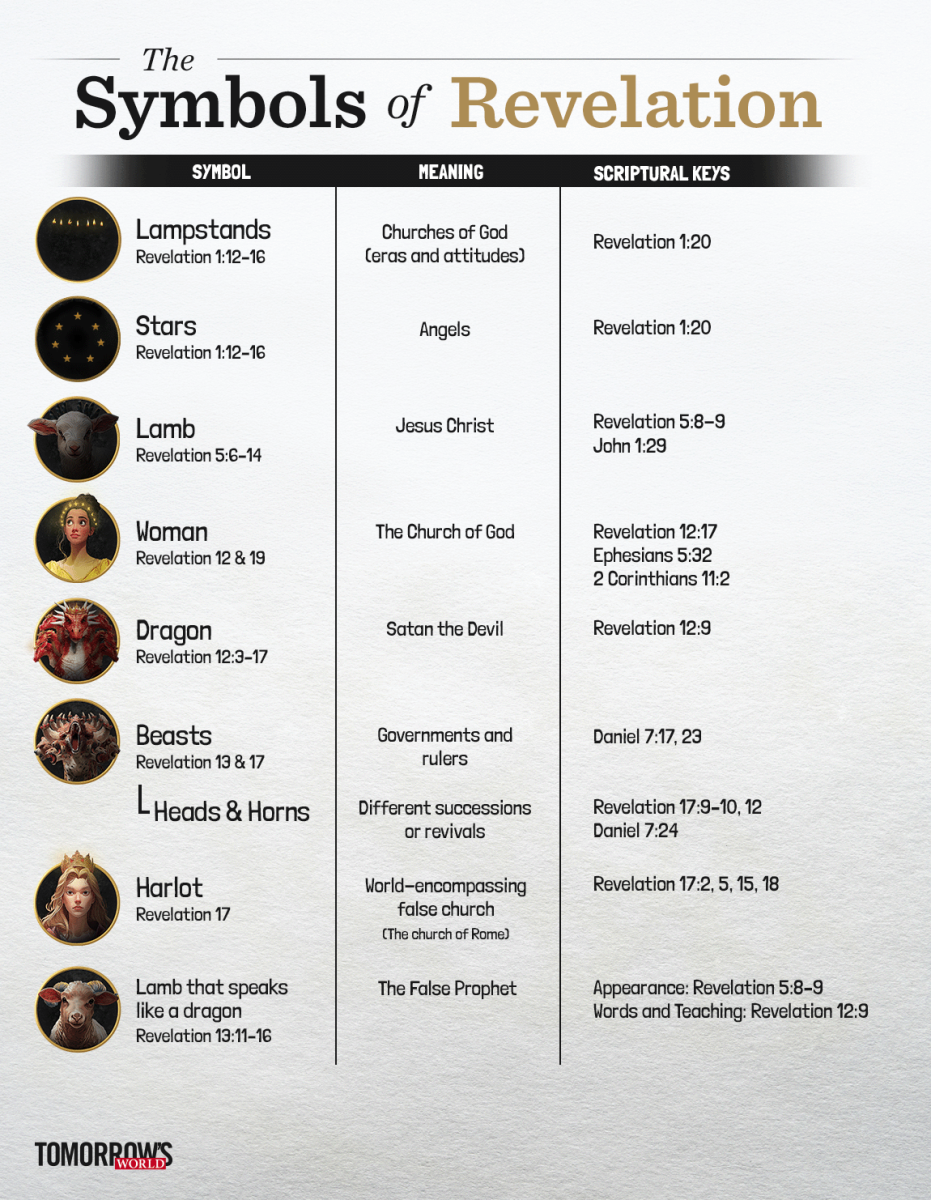
And as we do it, we’ll build a chart showing the symbol, the passage where it’s found, and then the passages used to interpret that symbol.
1. Seven Golden Lampstands and Seven Stars in Revelation
The first set of symbols we’ll explore are in Revelation 1:12–16. It says:
I turned to see the voice that spoke with me. And having turned I saw seven golden lampstands, and in the midst of the seven lampstands One like the Son of Man… [and] He had in His right hand seven stars….
So, what do these lampstands and stars represent? This is actually an easy one. All we need to do is go down to verse 20 and it tells us exactly what they picture. It says:
The mystery of the seven stars which you saw in My right hand, and the seven golden lampstands: The seven stars are the angels of the seven churches, and the seven lampstands which you saw are the seven churches.
The seven churches are then described in detail in chapters 2 and 3.
They are Ephesus, Smyrna, Pergamos, Thyatira, Sardis, Philadelphia, and Laodicea.
Each with its own unique characteristics and challenges.
In fact, back in verse 11, John was told to “write in a book” what he saw in his vision, “and send it to the seven churches” (Revelation 1:11).
So on our chart, we’ll write “lampstands,” “Churches of God (eras and attitudes),” and “Revelation 1:20” for the passage giving the interpretation.
And for the “Stars” we’ll write, “Angels,” and “Revelation 1:20” again.
2. The Lamb of God (Revelation 5)
The next symbol we’ll examine is the Lamb mentioned in chapter 5 and verse 6.
Now you might think this one is easy, and maybe it is, but there is another lamb mentioned later in the book that we’ll also cover in this video that you would not want to confuse with the one here in chapter 5. So let’s just nail it down.
The Lamb took the scroll with seven seals from “the right hand of Him who sat on the throne” (Revelation 5:6). Then the heavenly creatures bowed down before the Lamb. So we see He was worthy of worship. We see in verse 9 this Lamb was slain and redeemed us to God by His blood. Obviously, there is only One who has redeemed us to God by His blood.
And we read in John 1:29 when:
John saw Jesus coming toward him, [he] said, “Behold! The Lamb of God who takes away the sin of the world!”
So, the Lamb referenced in Revelation 5 is none other than the glorified Jesus Christ.
This is why we read in verse 12:
“Worthy is the Lamb who was slain to receive power and riches and wisdom, and strength and honor and glory and blessing!” (Revelation 5:12).
Back on our chart, we’ll write “Jesus Christ” for the meaning, and Revelation 5:9 and John 1:29 for the key for interpretation.
3. The Woman Clothed with the Sun (Revelation 12)
Now, as we continue deeper, our next symbol is the woman described in Revelation 12 and referenced again in chapter 19.
Revelation 12:1 introduces this woman, and in verse 5 we see she:
...bore a male Child who was to rule all nations… And her Child was caught up to God and His throne (Revelation 12:5).
This Child was clearly Jesus Christ (as He was the only One who was born and resurrected to sit down at the right hand of God the Father).
Then we see in verse 14 that the woman would go into protection for three-and-a-half years.
So how can we know who or what this woman pictures? Well, we’ll use three passages that help us understand.
The first is in verse 17. It says:
The dragon was enraged with the woman, and he went to make war with the rest of her offspring, who keep the commandments of God and have the testimony of Jesus Christ (Revelation 12:17).
Clearly a group of obedient people covered by the blood of Jesus Christ.
And the next verse that is even clearer is in Ephesians 5, known as the marriage chapter. Verses 22–33 describe how husbands and wives should treat each other.
And in verse 32, Paul states bluntly that he was not only discussing marriage between a man and a woman in the previous verses.
But I speak concerning Christ and the church (Ephesians 5:32).
Then in 2 Corinthians 11:2, Paul tells the Church at Corinth:
For I have betrothed you to one husband, that I may present you as a chaste virgin to Christ.
Ultimately, the woman in Revelation 12 pictures both the Old Testament “Church,” or Ancient Israel (pictured in the first 5 verses), as well as the New Testament Church of God that Jesus built, pictured in the remaining verses.
The male Child, or Jesus Christ, would come from Ancient Israel, or the Old Testament Church.
This woman, representing the Church of God, is the one who will marry Jesus Christ shortly after the resurrection as we read in Revelation 19:7–8.
For the marriage of the Lamb has come, and His wife has made herself ready. And to her it was granted to be arrayed in fine linen, clean and bright, for the fine linen is the righteous acts of the saints.
So for the meaning of the Woman in Revelation 12 and 19, we’ll write, “the Church of God,” and the key scriptures for interpretation.
Now, there is another woman mentioned in chapter 17, and we’ll get back to that in a bit.
4. The Fiery Dragon in Revelation 12
But first let’s talk about the dragon of Revelation 12.
And another sign appeared in heaven: behold, a great, fiery red dragon (Revelation 12:3).
This is our next symbol. Verse 4 says:
His tail drew a third of the stars of heaven and threw them to the earth. And the dragon stood before the woman who was ready to give birth, to devour her Child as soon as it was born (Revelation 12:4).
Now, well get back to this verse shortly to tie in some of the symbols we’ve already learned, but first let’s read the verse that clearly explains who or what this dragon is so we’re sure not to lean on our imagination.
Verse 9 states it clearly.
So the great dragon was cast out, that serpent of old [likely referring to the serpent we see in the Garden of Eden], called the Devil and Satan (Revelation 12:9).
Now, remember it said, “He drew a third of the stars of heaven and threw them to the earth”? And remember, we learned that the stars can represent angels (Revelation 1:20)?
Well, listen to the remainder of verse 9. It says:
He was cast to the earth, and his angels were cast out with him (Revelation 12:9).
The dragon clearly represents Satan and we don’t need to lean on our imagination to know this, because we read it clearly in verse 9.
5. The Beasts of Revelation 13 and Revelation 17
Next on our list is the symbol of the beast. There are two major beasts in Revelation, one in chapter 13 and the other in chapter 17.
In Revelation 13 we see “a beast rising up out of the sea, having seven heads and ten horns, and on his horns ten crowns” (Revelation 13:1).
This beast corresponds very closely with the beasts in Daniel 7, where we learn a lot about what [these] Beasts represent. For example, verse 17 says:
Those great beasts, which are four [mentioned earlier in the chapter], are four kings [or kingdoms] which arise out of the earth (Daniel 7:17).
So these beasts represent kingdoms or empires that have or will come to pass on the earth. Then we read in verse 24:
The ten horns are ten kings who shall arise from this kingdom (Daniel 7:24).
And back in Revelation 17:12, we read:
The ten horns which you saw are ten kings….
In other words, the beast represents a kingdom or empire, and the horns represent the kings or kingdoms those kings reign over.
Now the heads of these beasts often picture kingdoms as well, or even successions, or dynasties, of a larger kingdom as we see in Revelation 17.
The seven heads are seven mountains…. There are also seven kings. Five have fallen, one is, and the other has not yet come (Revelation 17:9–10).
So, we’ll capture all this on our chart.
If you want an in-depth explanation, watch our video about the Beast of Revelation.
6. The Harlot of Babylon in Revelation 17
The next symbol we’ll cover is the woman who rides the beast in Revelation 17.
In verse 2 we see a “great harlot who sits on many waters, with whom the kings of the earth committed fornication…” and she sat on the beast we just read about (Revelation 17:1–2).
Verse 5 highlights that she is:
Mystery, Babylon the great, the mother of harlots and of the abominations of the earth (Revelation 17:5).
Now, we already learned from the third symbol we covered that a woman often represents a church.
The one here in chapter 17 is definitely not the Church of God we read about earlier, pictured as a chaste virgin and the bride of Christ. Rather, this is an adulterous and fornicating harlot.
So we’re talking about a church that is deeply involved and intertwined with the kingdoms of the world.
In fact, the imagery of her riding the beast indicates she has a great deal of control over these kingdoms. In verse 15 we read:
The waters which you saw, where the harlot sits, are peoples, multitudes, nations, and tongues (Revelation 17:15).
In other words, this church has sway over people all around the earth, something much different than the “little flock,” as Jesus called His church (Luke 12:32).
And then in verse 18 we read that:
The woman whom you saw is that great city which reigns over the kings of the earth (Revelation 12:18).
Now there is one church, the church at Rome, with its own city, which has a history of ruling over kingdoms and which carries on with much of the Babylonian teachings and traditions.
In fact, it was this same false church that persecuted the Bible believing faithful saints of the true Church of God through the years, and we see this described in verse 6.
I saw the woman, drunk with the blood of the saints and with the blood of the martyrs of Jesus (Revelation 17:6).
Again, labeled as the “Mother of Harlots,” she has many daughter churches that have come out from her who also are not faithful to the word of God and Jesus Christ.
And as we get these details on the chart, we’ll highlight that it is this great and powerful false church that brings us to the seventh symbol we’ll discuss in this video.
7. Lamb with Two Horns That Speaks Like a Dragon (Revelation 13:11–18)
And that is the beast that looks like a lamb back in Revelation 13. In verse 11 we read:
Then I saw another beast coming up out of the earth, and he had two horns like a lamb and spoke like a dragon.
With this one, we can simply put together much of what we’ve already learned.
The beast pictures a kingdom or institution that looks like it represents Jesus Christ on the surface, but speaks the good-sounding deceptive teachings and doctrines of Satan the Devil.
In Matthew 12:34 we learn that “out of the abundance of the heart the mouth speaks.”
We’re talking about a false Christian church that “deceives those who dwell on the earth by those signs which he was granted to do in the sight of the beast” (Revelation 13:14), and insists that all give their allegiance and loyalty to the first beast in Revelation 13 that we’ll identify in another video as the Holy Roman Empire.
Jesus Himself warned that:
Many will come in My name, saying, “I am the Christ,” and will deceive many (Matthew 24:5).
And that:
False christs and false prophets will rise and show great signs and wonders to deceive, if possible, even the elect (Matthew 24:24).
So again, the beast that looks like a lamb and speaks like a dragon is a great false church.
So, we’ll add these details to our chart.
But why does this beast have two horns?
As we saw earlier, the horns represent rulership and authority. Well, the Church of Rome is both an ecclesiastical and a civil government. The pope is both a religious leader and a civil head of state. Bible prophecy shows that the church-state union of the Middle Ages was a forerunner of end-time events whose scale will be far grander.
And from other prophecies, this beast that looks like a lamb and speaks like a dragon not only represents the false Christian system itself, but also the end-time prophet himself known as the Antichrist.
You need to know all you can before he comes on the world scene, and you can by watching our video: “Who Is the Antichrist: Two Critical Facts to Know BEFORE the Final One Shows Himself.”
This video puts together the passages throughout the Bible that mention this false prophet and paints a picture to help you avoid deception.