


To use our advanced search functionality (to search for terms in specific content), please use syntax such as the following examples:
- Armageddon Magazine Article
- Apology Commentary
- Europe News & Prophecy
- Christmas Telecast
- Baptism Booklet
- Sabbath Roderick C. Meredith
- Abortion Gerald Weston
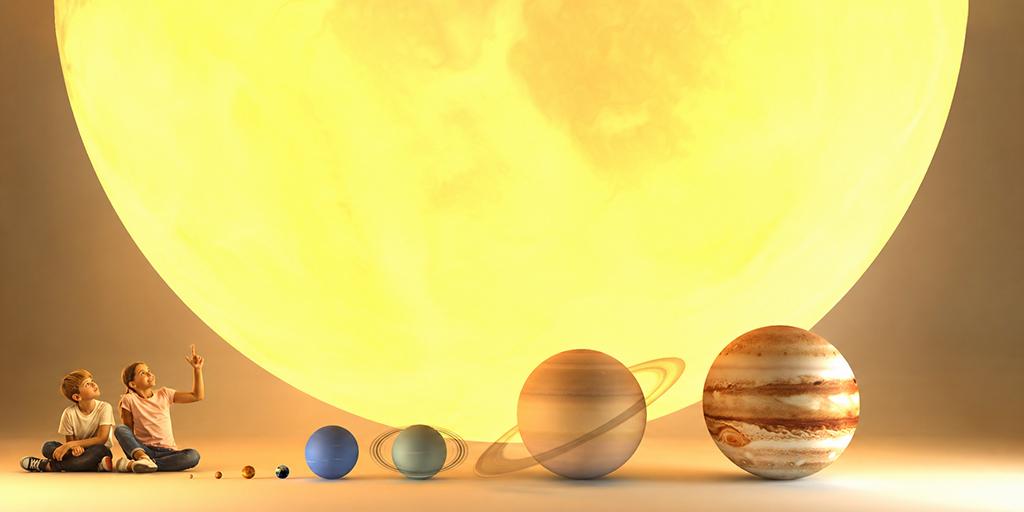
Small, but Packed with Potential
Models can’t do justice to the proportions of our solar system, but God’s word tells us that even the vast, immeasurable sky above isn’t the limit to the true potential of God’s children.
It staggers the mind to consider the tiny planets of our solar system against the backdrop of the emptiness of space. Beyond the clouds in the sky is a space so very vast and so empty that it is all but impossible for the human mind to grasp—despite some very clever attempts at creating models for visualization!
One highly impressive digital model can be found at SolartoScale.com, the work of designer and developer Reuven Frank. According to this model, if celestial bodies could be represented at a scale of one pixel per 1,000 kilometers, the Sun spans 1,391 pixels, while Earth is a mere 12.7 pixels wide. This means the Sun’s diameter is about 109 times that of Earth’s. The reality is that the Sun is so large that more than a million Earths could fit inside it.
The real mind-boggler is to realize how much greater the planets’ distances from the Sun—and generally from one another—are than the diameters of the planets themselves.
For example, the distance from the Sun to Earth is nearly 12,000 times greater than Earth’s own diameter, and by the time we get to Neptune, the distances become nearly incomprehensible, which is why “it’s practically impossible to create a visual representation on a screen or the page of a book that realistically represents the sizes of the planets and the distance between them” (“Solar System Size and Distance,” NASA Jet Propulsion Laboratory, September 18, 2024).
On our scale, Mercury registers at just about 5 pixels and Mars at only about 7 pixels. They would appear to be nothing more than tiny specks or pebbles compared to the gas giants Jupiter and Saturn. With Jupiter’s 139 pixels and Saturn’s 116 pixels, we begin to see just how insignificant the rocky inner planets are in terms of raw size, even though we call one of them home.
Now compare the gas planets to the ice planets. Jupiter (a gas giant) is almost three times wider than Uranus (an ice giant), showing just how dramatically planetary sizes tend to differ as you move from one planetary composition to another. If each pixel of our hypothetical model equals 1,000 kilometers (621 miles), Jupiter’s 139-pixel diameter translates to roughly 139,000 kilometers (86,370 miles) across, while Earth’s 12.7-pixel diameter is minuscule at about 12,000 kilometers (7,918 miles).
Perhaps the most humbling or inspiring realization we can have is that to scale planet sizes relative to their orbital distances accurately on one page, the planets become microscopic dots no one could see. The only way to actually witness the true scale of our solar system via physical models is by using a large area, such as a football field or an open desert, because our screens and pages simply aren’t big enough to do justice to the real proportions.
Yet, in spite of all this, the size of our solar system should by no means make anyone feel insignificant. Humble, yes—but not insignificant. The Bible, the inspired word of God, makes it plain that He created earth and the heavens (Genesis 1:1; Psalm 8:3–4). Once this awe-inspiring truth is understood, the question becomes why? God’s word shows us that man was created for a purpose. We, each of us individually, have the potential to be crowned with glory and honor and given dominion over all the work of God’s hands (Hebrews 2:5–8). This is a purpose that is absent from nearly all the teachings of mainstream “Christianity,” and it is a truth that will make even the vast solar system seem like a small thing by comparison.
Find out more about this purpose by studying the free booklet What Is the Meaning of Life? This fully biblical resource is free and available online or in print. Order yours today.
Stay up to date with our Weekly Digest Email!
Tomorrow's World ComMentary Podcast
Subscribe to Tomorrow's World Commentary podcasts on iTunes and Google Play!