


To use our advanced search functionality (to search for terms in specific content), please use syntax such as the following examples:
- Armageddon Magazine Article
- Apology Commentary
- Europe News & Prophecy
- Christmas Telecast
- Baptism Booklet
- Sabbath Roderick C. Meredith
- Abortion Gerald Weston
The View from 1526
The fall of the ancient kingdom of Israel was about as distant from the reign of King David as Americans are today from the founding of their nation. Much can change in 250 years.
As the United States prepares to observe its semiquincentennial on July 4—the 250th anniversary of the signing of the Declaration of Independence, which announced the founders’ intent to separate from Great Britain—Americans are reflecting on the ways their nation has changed since then. But can you imagine yourself, in 1776, looking back 250 years before the birth of your nation?
In 1526, no enduring European settlements had taken root in what would become the United States. Jamestown in Virginia would not be founded until 1607. But in September of 1526, Lucas Vázquez de Ayllón brought some 600 Spanish colonists to North America (about six times as many as sailed on the Mayflower in 1620 to launch the Plymouth Colony) to build a town called San Miguel de Gualdape. Its exact location remains unknown, somewhere in today’s Georgia or South Carolina, and it failed within a few months—ravaged by disease, famine, and strife.
We commonly think of colonists coming to America in search of religious freedom, but the San Miguel de Gualdape settlers were not religious dissenters—they were Catholics loyal to Pope Clement VII (whose conflict with England’s King Henry VIII would spark creation of the Anglican Communion) during a time of religious turmoil across Europe. In 1526, Martin Luther and Ulrich Zwingli had recently begun to promote what would later be called the Protestant Reformation, and William Tyndale’s first printed New Testament had just begun to circulate among English-speakers.
As for freedom, we may be sobered remembering that Ayllón’s expedition was the first to bring slaves to North America, and it suffered what is often considered North America’s first slave rebellion. By 1776, slavery was still legal in the Americas, and more than 40 of the 56 men who signed the Declaration of Independence were slaveowners. But in the 250 years since Ayllón’s settlement failed, much else had changed.
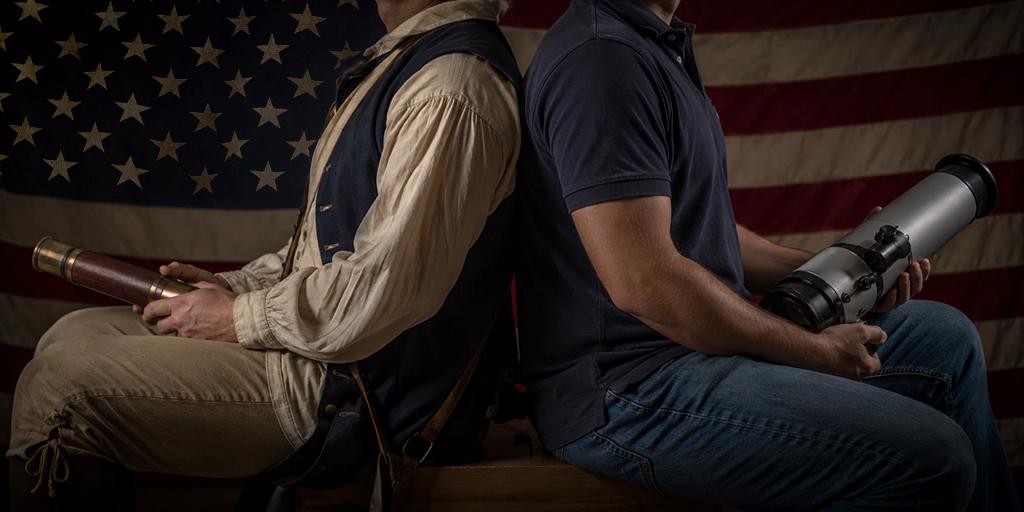
When Tyndale printed his English-language Bible in 1526, he was using a new and still-revolutionary technology, but by 1776 printing was so widespread that revolutionary colonists could readily mass produce pamphlets promoting their cause. Scientists in 1776 used telescopes and microscopes—neither of which existed in 1526. Ordinary people owned household clocks—unheard of in 1526—and the well-off carried pocket watches. Mathematicians in 1776 had the benefit of calculus and probability theory—in 1526 the work of Leibniz (1646–1716), Euler (1707–1783), and Newton (1642–1727) was still more than a century in the future. And in July of 1776, Thomas Jefferson began compiling his extensive weather observations using sealed mercury-in-glass thermometers—devices unknown in 1526.
And while America’s Founding Fathers often paid homage to the Bible and to classical Greece and Rome, they were most powerfully influenced by seventeenth- and eighteenth-century philosophers such as John Locke (1632–1704), Montesquieu (1689–1755), and Jean-Jacques Rousseau (1712–1778). As Tomorrow’s World presenter Wallace G. Smith explains in his July-August 2026 Tomorrow’s World magazine article, “American Liberty: Its Promise and Its Price,” the Declaration of Independence was built on principles that in 1526 had not yet even been articulated.
Indeed, many aspects of daily life in 1776 would have been unimaginable in 1526. So, today, when we try to look 250 years into our future—to the world of 2276—can we hope to have any realistic vision of that time? Will planet Earth become a radiation-poisoned hellscape devastated by nuclear conflict? Will it be a desert wasteland made unlivable by out-of-control global warming? Or will it be a lush green paradise, where people live in peace and harmony as never before?
While many details will only emerge with the passage of time, there is a reliable source of information that can tell us what we most need to know. That source is your Bible, which reveals the end-time events leading to Jesus Christ’s return to establish the Kingdom of God and inaugurate the prophesied Millennium on planet Earth (Revelation 20:4–6). And you can see it for yourself. If you haven’t already done so, please read our inspiring and informative resource The World Ahead: What Will It Be Like? It will give you hope and encouragement as you discover the future of our planet—and of the billions of human beings who have ever lived.
Stay up to date with our Weekly Digest Email!
Tomorrow's World ComMentary Podcast
Subscribe to Tomorrow's World Commentary podcasts on iTunes and Google Play!